Dentures
Complete Dentures Versus Partial Dentures
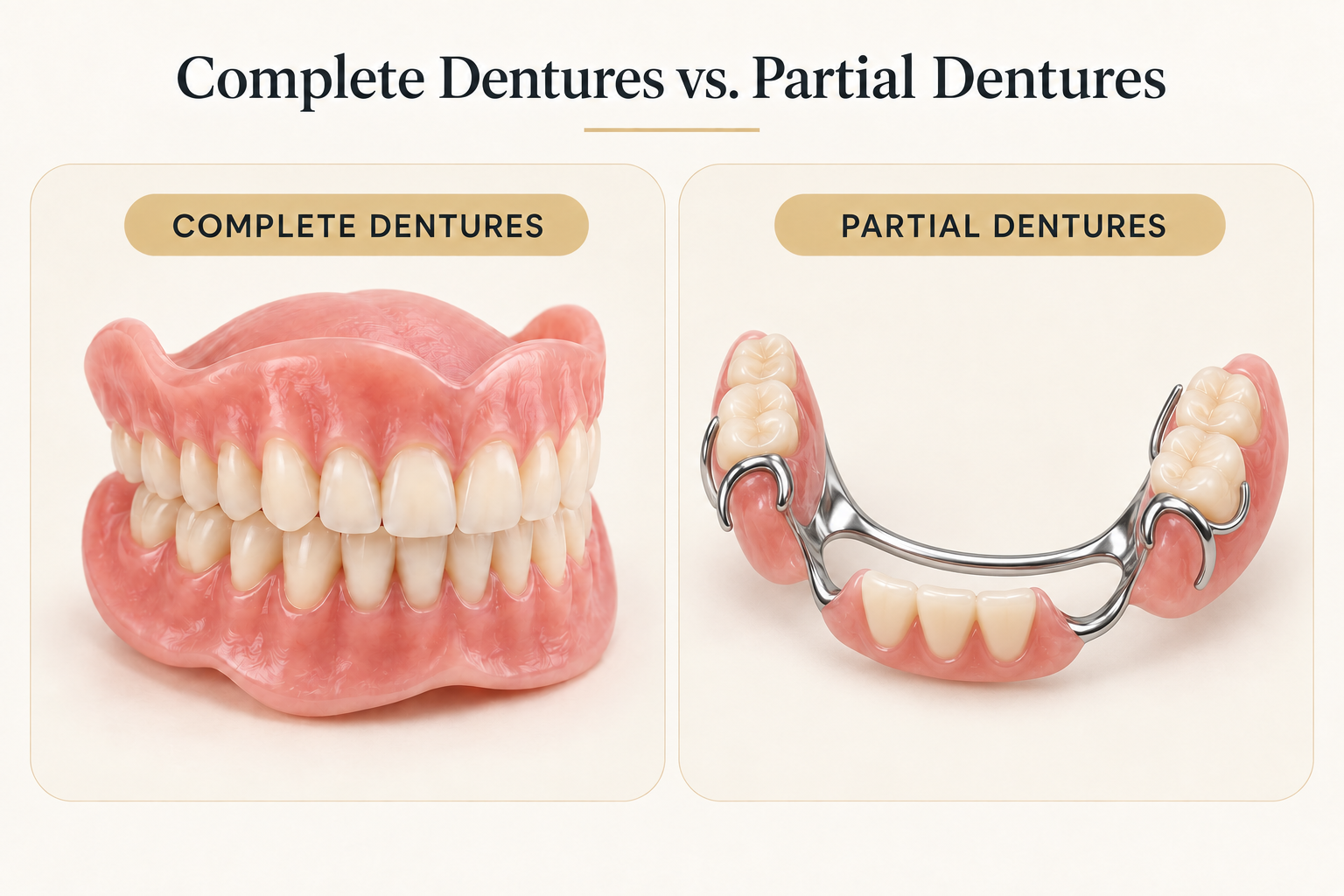
A complete denture replaces all the teeth in an arch and rests on the gums; a partial denture replaces only some teeth and clips onto the teeth you still have. If you have healthy remaining teeth that can support it, a partial denture is usually more stable and more comfortable than a complete one.
How a complete denture works
A complete (full) denture replaces every tooth in the upper jaw, lower jaw, or both. It is a removable acrylic appliance that rests directly on the gums and is shaped to support the lips and cheeks. The upper denture typically gets good suction across the palate; the lower complete denture has less to hold onto and is naturally less stable.
Tooth shade, shape and arrangement are chosen with you so the result looks natural rather than generic. A complete denture is the right option when no usable teeth remain, or when remaining teeth cannot be saved as advised by your dentist.
How a partial denture works
A partial denture fills the gaps left by missing teeth while keeping the healthy teeth around them. It uses clasps or precision attachments on your natural teeth for support and retention, which makes it noticeably more stable than a complete denture — especially on the lower arch.
Because it anchors to existing teeth, a partial denture also helps keep those teeth from drifting into the empty spaces. It can have a metal framework for strength and a thin profile, or an acrylic base, depending on the case.
Which one is right for you
The deciding factor is the condition of your remaining teeth. If they are healthy enough to support clasps and bear some load, a partial denture is generally the better choice for stability and chewing. If they cannot be saved, a complete denture — or an implant-retained option for the lower arch — is the path forward.
We assess this together at a complimentary consultation, and where extractions are involved we coordinate with your dentist. The goal is the option that fits your mouth, your budget and your goals — not a one-size recommendation.
Common Patient Questions
Can I switch from a partial to a complete denture later?
Yes. If remaining teeth are eventually lost, a partial can be replaced with a complete denture. Keeping natural teeth as long as they are healthy is usually preferable, which is why we do not rush to extract.
Why is my lower complete denture looser than the upper?
The upper denture covers the palate and creates suction across a wide area. The lower arch has less surface area and the tongue and cheeks constantly move around it, so lower complete dentures are naturally less stable — an implant-retained lower denture is one solution.
Do partial dentures damage the teeth they attach to?
A well-designed and well-maintained partial does not. Clasps need periodic checks, and the supporting teeth need to be healthy. Your annual checkup lets us catch any issue early.
Related Nova Service
Complete Dentures
Learn more about this treatment, including the process, aftercare and coverage, on the dedicated service page.
Visit the Complete Dentures pageRelated Articles
This article is general information only and does not replace an individual examination, diagnosis or treatment plan. Your situation is unique — please book a consultation so we can assess your mouth and advise you in person.
Have a Question About Your Dentures?
Book a complimentary consultation in Kingston and we will review your situation in person and explain your options clearly.